WildfireGuardian
Next-generation wildfire detection and prediction system using advanced sensor networks and AI. Provides real-time monitoring and predictive analytics to protect communities and ecosystems.
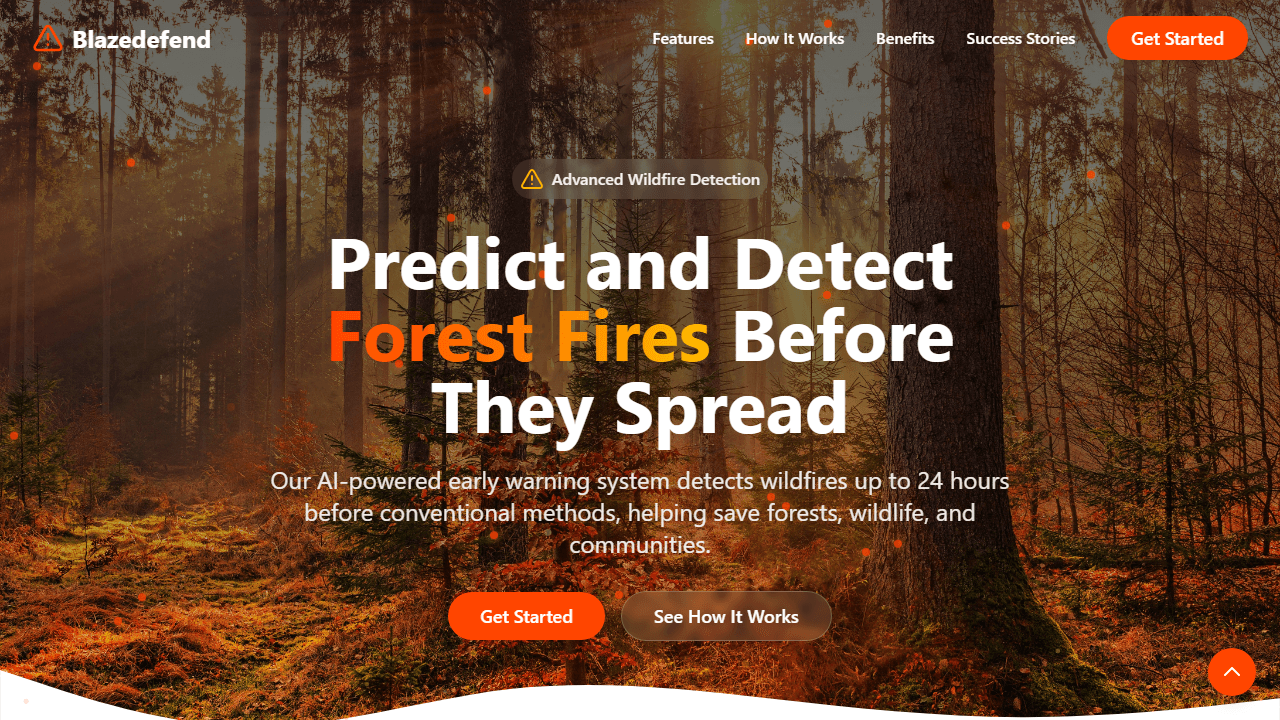
Overview
WildfireGuardian (BlazeDefend) is a cutting-edge IoT solution designed to combat the growing threat of wildfires. By leveraging a network of advanced sensors and artificial intelligence, the system detects early signs of fire with high accuracy. It processes environmental data in real-time to predict fire spread patterns, enabling rapid response from emergency services. The platform features an intuitive dashboard for monitoring hazard levels across vast geographical areas.
Key Features
- Real-time Detection: Instant alerts from sensor networks.
- Predictive Analytics: AI modeling of fire spread and risks.
- Sensor Integration: Seamless connection with IoT hardware.
- Alert System: Multi-channel notifications for rapid response.
How it was built
The problem
Wildfire response is a race that is usually lost before anyone knows it has started. The window in which a fire is still cheap to stop is short, and the systems that detect fires mostly operate on a slower clock than that window. Satellite passes are periodic rather than continuous, so a fire that starts just after an overpass has time to establish itself before anything looks again. Lookout towers and public reports depend on somebody being present and awake with a line of sight. By the time a fire is large enough to be obvious from a distance, the cost of stopping it has already moved by orders of magnitude, and the decision has changed from suppression to evacuation.
The gap is not really a sensing problem. Temperature, humidity, and the chemical signature of combustion are all measurable with inexpensive hardware. The gap is that the places where fires start are exactly the places with no mains power, no reliable network, and nobody to maintain equipment — and that an alerting system operating in that environment has a failure mode far more dangerous than missing a fire. A system that produces false alarms gets muted, and a muted system has negative value, because it occupies the place in the response chain that a working system would otherwise hold. BlazeDefend was built around that constraint rather than around detection sensitivity.
Approach & architecture
The architecture separates three concerns that are easy to conflate: what a single sensor observed, what the system believes is happening, and what a human is asked to do about it. Treating these as one pipeline is what produces brittle alerting, because it lets a single noisy reading become a siren.
At the edge, the design assumption is scarcity. A node in a remote area has a finite energy budget and an intermittent, low-bandwidth link, which means it cannot stream raw telemetry and cannot be woken on demand. Nodes therefore sample on a duty cycle and transmit compactly, spending their power budget on sensing rather than radio time. This has an architectural consequence that shapes everything above it: the system never has complete, current knowledge of the field. It has a sparse, slightly stale picture, and every layer above has to be honest about that rather than papering over it.
Ingestion is therefore append-only. Readings arrive out of order, late, or in bursts after a node reconnects, so they are stored as timestamped observations that are never overwritten. A late reading is a new row, not a correction, which keeps the history of what was known at each moment intact — necessary both for tuning detection logic and for reconstructing afterwards why an alert did or did not fire.
Detection sits above that as an interpretation layer rather than a threshold on a single value. A single sensor reporting a high temperature is weak evidence; it could equally be direct sun on a housing, a failing component, or a genuine fire. Corroboration across neighbouring nodes and across time carries far more signal than any individual reading, so the question the system asks is not whether a reading crossed a line but whether a pattern is consistent across space and trending in a direction that matters.
The dashboard is deliberately a read model over that interpretation, built with Next.js and streamed to operators. Its job is situational awareness — hazard levels across an area, which nodes are reporting, which have gone quiet — and it is designed so that an operator can always distinguish a calm area from an unobserved one.
Engineering challenges
False alarms are more dangerous than missed readings
An alerting system is only as useful as the attention it still commands. Every false alarm spends credibility, and once responders start treating notifications as probably noise, the system has become worse than nothing, because it occupies a slot in the response chain that something trustworthy would otherwise fill. That makes sensitivity a trade rather than a goal. The design leans on corroboration instead of thresholds: agreement between neighbouring nodes, and movement over time in a direction consistent with combustion rather than with weather or with a sensor drifting. A single dramatic reading from a single node is treated as a reason to look more closely, not as a reason to wake somebody up.
Sensors live where there is no power and no network
The deployment environment is the hard constraint, and it is fixed. A node cannot assume mains power, cannot assume continuous connectivity, and cannot assume anybody will visit it for a long time. Radio is usually the largest consumer in that budget, which means the cheapest way to extend a node's service life is to transmit less rather than to sense less. Nodes accordingly sample more often than they report and send compact summaries rather than raw streams. The consequence — sparse, sometimes delayed data — is accepted as a property of the system and handled upstream, rather than being hidden behind interpolation that would invent confidence the data does not support.
Silence is ambiguous and has to be surfaced as such
When a node stops reporting, there are at least three explanations: the battery is flat, the link is down, or the node no longer exists because something burned it. These demand completely different responses, and a dashboard that renders all of them as an absence of alerts communicates the most dangerous of the three as calm. The system therefore treats liveness as its own signal, distinct from hazard. An area with no recent readings is displayed as unobserved rather than as safe, so an operator can tell the difference between nothing happening and nothing being known — which is the distinction that decides whether somebody drives out to look.
Predictions are only useful if their inputs are visible
Spread modelling produces an output that looks authoritative — a projected direction, an area at risk — and that confidence is itself a hazard when the underlying inputs are sparse or stale. A projection built on three nodes that last reported some time ago should not be presented the same way as one built on dense current data. The system keeps the provenance attached to the projection: which observations fed it and how recent they are. A responder deciding where to commit limited people and equipment needs to know how much weight the estimate can carry, and that judgement cannot be made from the estimate alone.
Stack decisions
- Edge nodesDuty-cycled sampling with compact, batched transmission
- Energy is the binding constraint in remote deployment and radio dominates the budget. Sampling more often than reporting keeps temporal resolution where it is cheap while spending as little as possible on the expensive part, which is what determines how long a node survives unattended.
- IngestionAppend-only, timestamped observations
- Readings arrive late, out of order, and in bursts when a node reconnects. Never overwriting means a delayed reading is additional evidence rather than a destructive edit, and it preserves the record of what was known at each moment — which is what makes both detection tuning and after-the-fact review possible.
- DetectionCross-node corroboration and trend analysis over single-value thresholds
- One sensor reporting an extreme value is weak evidence that is equally consistent with a hardware fault or direct sun. Agreement between neighbouring nodes, and movement in a direction consistent with combustion, is where the actual signal lives — and it is the only approach that keeps the false-alarm rate low enough for the alerts to stay trusted.
- DashboardNext.js with streamed server rendering over a read model
- Operators need current state fast and on whatever device is at hand. Rendering on the server and streaming keeps first paint quick over poor connections, and building the view over an interpretation layer rather than raw telemetry keeps display logic out of the detection path.
- LivenessNode health tracked as a first-class signal, separate from hazard
- A quiet node and a safe area look identical if silence is not modelled explicitly. Separating them lets the interface show unobserved areas as unobserved, which is the difference between an operator knowing they have coverage and assuming it.